



01 Jul Looking for AI Winners & Losers – 2026 Q3 Commentary
Looking for AI Winners & Losers
A quarter has passed since we described the “SaaSpocalypse.” You may be asking yourself whether we are starting to see Artificial Intelligence (AI) winners and losers emerge. That question is complicated and we do not think enough time has passed to really answer it. However, the market is telling us that it is beginning to differentiate winners and losers. Similarly, corporate data and economic statistics seem to be providing some answers as well.
Mid-February 2026 to March 31st provided a swift 10% downdraft in the S&P 500. That led to a second quarter rebound where the market suggested that some types of software businesses would not face disintermediation from AI and others would. For example, the Morris & Wells cybersecurity investments performed very well from a stock market perspective while other software businesses that we owned declined in value. That occurred throughout the sector. Graph 1, below, illustrates that all of the year-to-date market capitalization gains in the S&P 500 came from Energy and AI companies. The rest of the index lost market capitalization. The stock market appears confident in its assessment. Whether corporate fundamentals agree is a different question.

Several of the software businesses referred to above experienced reasonably good March quarter results and provided steady forward earnings guidance. When you compare that to stock market performance, you get a classic case of “is the market wrong?” If company earnings continue to be uninterrupted by competition from AI, some of the downtrodden software stocks should regain market value. Likewise if company earnings deteriorate as a result of increased competition from AI, then the market will be proven correct about those losers. We believe it is too early to tell with certainty, and that at the moment the dichotomy between stock market performance and corporate earnings performance is as interesting as we remember. We remain patient, monitoring corporate results and looking for opportunity. The discussion above centered on stock market performance in the debate about AI winners and losers. From a corporate performance perspective we have not seen a large uptick in corporate profit margins except among the large technology companies. Graph 2, below, illustrates that the so-called “Magnificent 7” large technology companies have experienced the widest profit margin expansion among S&P 500 companies. However, the S&P 493’s profit margin has remained stable over the last decade. That may just illustrate the market power of the tech behemoths, but it likely shows that the efficiency benefits of AI have not dropped down to corporate bottom lines except at the largest companies. So differentiating AI winners and losers from high-level corporate data is still difficult at this point. It is possible that AI still benefits companies but does not necessarily increase operating margins. AI might just allow companies to sell more goods and services without increasing profit margin. We are monitoring the corporate deployment of AI and looking for opportunities created by that deployment.

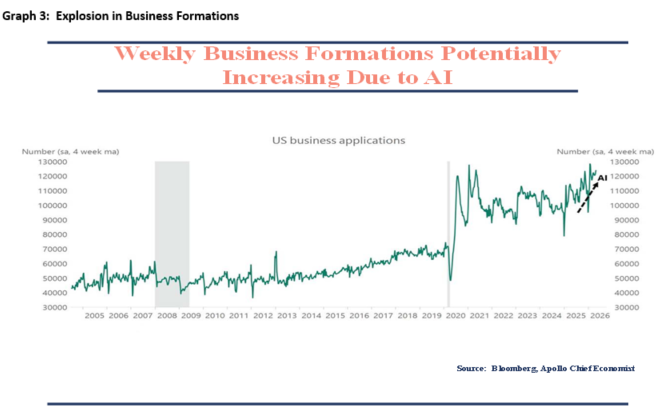
Not every AI winner will be an established public company. One group already benefiting appears to be entrepreneurs. Graph 3, below, depicts weekly US business applications exploding higher around the onset of Covid 19, but not settling to prior levels and even taking another leg up in the last two years. We think it is reasonable to believe that this is a result of the tools AI provides entrepreneurs to build companies with fewer resources. Many of those businesses will fail but that is the nature of entrepreneurship. One of the things that makes America great is the ability to try one’s hand in business formation and AI appears to be assisting in that area.

Another frequently discussed AI loser is recent college graduates. We have seen a number of media reports that suggest recent college graduates are one clear loser from AI. Graph 4, above, does show overall college graduate unemployment rates ticking up. However, since the onset of large language model ChatGPT in 2022, the gap between overall college graduate unemployment and recent college graduate unemployment has remained constant. Again, we think it is too early to define recent graduates as AI losers. Similar to the tone of this whole newsletter, there appears to be a general wait and see approach in terms of hiring. Companies want to learn what AI can and cannot replace or augment. We remain excited about the opportunities, but continue to monitor data like employment statistics for clues to the AI winners and losers.
The stock market has begun to differentiate AI winners and losers. Corporate data seem less definitive from the perspective of both their margins and hiring practices. Entrepreneurs also appear to be using AI tools to realize their dreams. As we stated in our second quarter newsletter, the process of differentiating winners and losers will be an issue that remains with us for several years. We expect to see many opportunities in the market as a result of that differentiating process, and continue to search for those.
During the second quarter the team at Morris & Wells had the chance to work with a great film producer on a short video to use as an introduction to our firm and place on the homepage (www.morrisandwells.com). We are hoping that the project is finished and on the site by the end of summer. The experience was hard work, but fun. The best part of it was working with some of you and being reminded how much we love working for all of you and experiencing the ups and downs of life with you. Thank you!
Sorry, the comment form is closed at this time.